

The briefing · Vol. 08 · No. 007
29 September 2026 · In-space economy · Policy & capital · 10 min read
Booked through 2029
$1B more for Stoke to fly Nova Pathfinder in early 2027 and build a 15-ton Block 2 for 2029. BAE clears design review on the $1.2B MEO missile-warning program; 10 satellites move toward production. True Anomaly and Northrop win GHOST-R prototypes for GEO reconnaissance, with a path into RG-XX. NOAA buys $28.4M of PlanetiQ radio occultation data, up to $47.3M with options by the company's count. Foothold opens on what the Station's exit frees and what it cannot prove.

What this issue is actually about
Every commitment here lands before the Station retires in 2030, and each one gets the same funded, flown, second-source test. Stoke has the money for a first orbital flight in early 2027, not the flight. BAE has a $1.2B program and a passed design review but a single prime, with its first satellite due in FY2029. GHOST-R has two prototype contracts, a built-in second source, and no public price; the satellites launch in 2028 and have to earn their way into RG-XX by 2029. PlanetiQ is the one piece already flying, delivering data to an agency that rents from three suppliers instead of owning a constellation. Foothold 1 of 6 then puts low Earth orbit after the Station through the same test and finds the lunar surface seat still open.
Launch
Stoke raises $1B to fly Nova and build Block 2

Stoke Space has $1 billion more to get a fully reusable rocket to orbit. The initial close of its Series E brings total capital raised to $2.3 billion. Point72 Ventures and Spark Capital co-led the round, announced Sept. 8, with Woven Capital, Y Combinator, and other new and existing investors in the book.
The money has two jobs. The first is getting Nova Pathfinder to orbit. The Kent, Washington company is targeting early 2027 for Pathfinder's first orbital launch, which will carry payloads while testing Nova's full-reuse architecture in flight. The second job is a bigger rocket. Nova Block 2, already in development, is rated for 15 metric tons to low Earth orbit in a 5-meter fairing, with first launch targeted for 2029. The round also pays for manufacturing, test, launch, and recovery infrastructure.
Block 2 is a customer call. CEO Andy Lapsa told Reuters that customers are "moving up in both size and quantity of their spacecraft," and that constellation operators will need rockets to replace aging satellites. Block 2 runs 14 of Stoke's Zenith engines, twice Pathfinder's count. Reuters also reported that reusable Pathfinder is designed to lift 3 metric tons to LEO, or 7 expended, and that Lapsa calls its manifest fully booked "for the next couple years."
The money is real, and Reuters confirms it. The rocket has not reached orbit. Full reuse stays a design claim until Pathfinder brings hardware back and flies it again.
Early 2027 is the first gate. Block 2 inherits whatever Pathfinder learns about turnaround, so the 2029 date is only as firm as that first recovered stage.
Backlog
BAE clears design review on $1.2B MEO missile warning

Ten missile-warning satellites for medium Earth orbit can now move to production. BAE Systems completed the Critical Design Review for the Space Force's $1.2 billion Resilient Missile Warning & Tracking (RMWT) MEO Epoch 2 program, the company announced Sept. 21. Space Systems Command runs the program. BAE is prime.
A CDR verifies that a design meets operational, performance, and safety requirements and can advance to production. BAE cleared it on schedule, 14 months after award. The company credits digital modeling done with the customer and long-lead parts bought over the past year. Some components are already in early production, drawing on its TREK spacecraft bus and infrared optical payload work.
The scope is hardware plus ground. BAE will design and build 10 spacecraft to warn of and track ballistic missiles and advanced threats, including hypersonic glide vehicles. It also delivers the ground system that runs the constellation: mission management, command and control, and mission operations. The Defense Post reports a four-year delivery period followed by five years of operations and support, with the first Epoch 2 satellite due in fiscal 2029. Those satellites join the 12-satellite Epoch 1 layer from Millennium Space Systems and L3Harris, which begins launching in 2027. The Space Force plans a baseline MEO constellation of about 30 satellites, refreshed with new capability every two to three years.
Funded, with The Defense Post backing BAE's account. Nothing has flown.
One prime, with no second source, now holds bus, infrared payload, and ground control for Epoch 2. FY2029 is when that vertical line has to show up as a delivered satellite.
Backlog
True Anomaly and Northrop picked for GHOST-R GEO recon
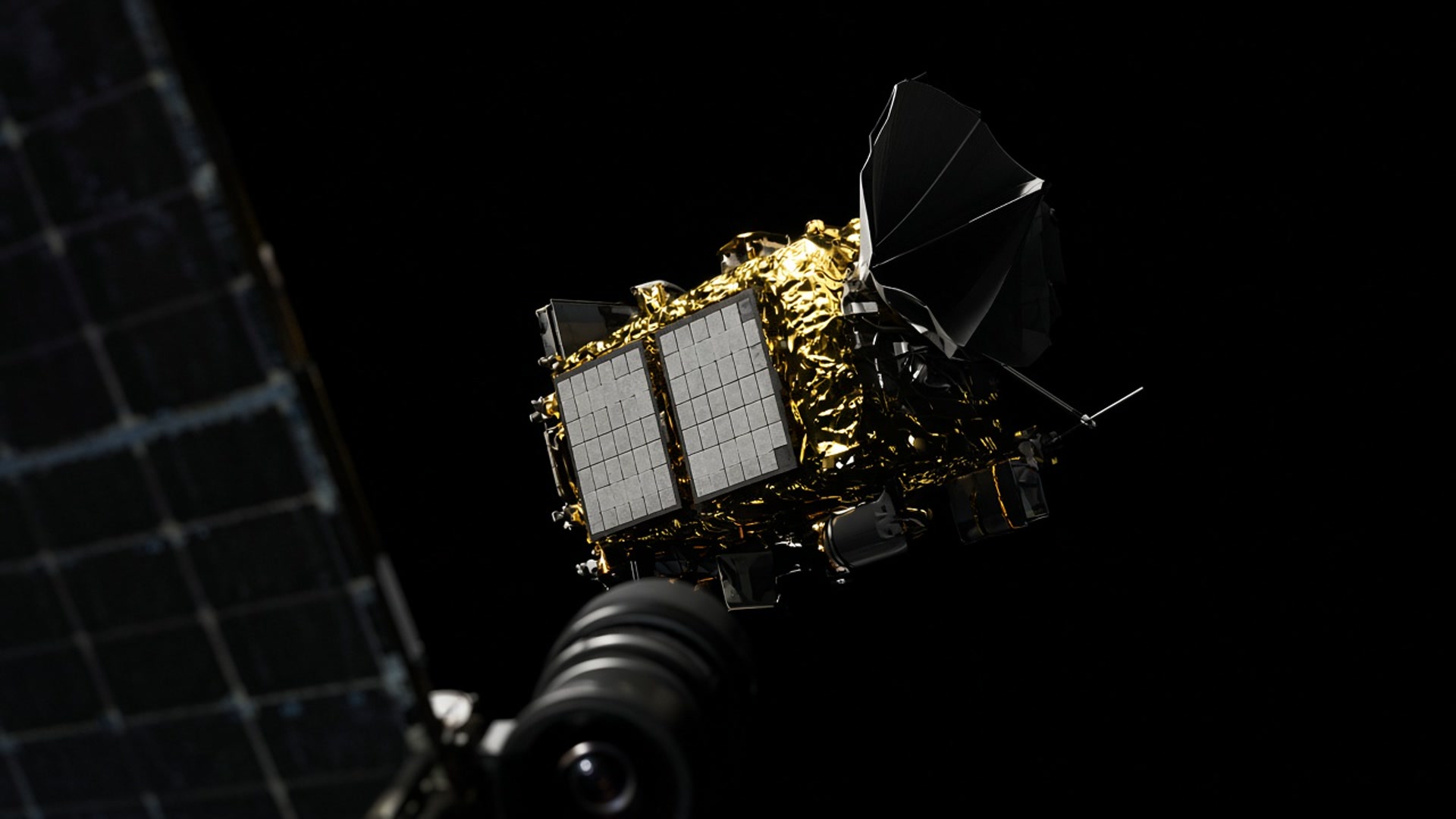
Geosynchronous orbit carries missile warning, strategic communications, and national intelligence satellites, and the Space Force wants cheaper eyes on everything else parked there. The Defense Innovation Unit and Space Systems Command awarded prototype contracts to True Anomaly and Northrop Grumman on Sept. 18 under GHOST-R, the Geosynchronous High-Resolution Optical Space-Based Tactical Reconnaissance program.
The job is close-range, space-to-space imaging for characterizing resident space objects, battle damage assessment, and positive identification. Ground sensors do that work through the atmosphere and at long range, and hit limits on both. GHOST-R feeds RG-XX, the Space Force program of record for a proliferated GEO reconnaissance layer. "Successful prototypes will have a direct transition into the program of record," said Col. Bryon McClain, acting portfolio acquisition executive for Space Combat Power.
True Anomaly delivers its Jackal autonomous vehicle plus Mosaic, its command-and-control software for mission planning and training. The company operates Jackal jointly with Space Force crews first; it then becomes a government-owned, government-operated RG-XX asset. Northrop builds on ESPASat-L, a suitcase-sized bus, with optical payloads from TRL11, an Irvine, California supplier, and commits to delivering an operational prototype in 24 months. Northrop also built GSSAP, and Payload reports that the small fleet now watching GEO is mostly GSSAP satellites. Trade reports put launch in 2028 and government-run missions by 2029.
The contracts are real, confirmed beyond the companies by a Defense Department notice and trade coverage. Two vendors on one requirement give the program its second source. The price is undisclosed, and nothing has flown.
The Space Force has put the GSSAP builder and a purpose-built challenger on the same 2028 clock. A prototype that images its targets on time earns the direct path into RG-XX, the program that buys the layer.
Policy & capital
NOAA buys $28.4M of PlanetiQ radio occultation data

NOAA is paying PlanetiQ for measurements, not satellites. The agency's NESDIS Commercial Data Program awarded the Golden, Colorado company a two-year task order that NOAA puts at $28,413,038 base, with surge options that PlanetiQ says bring the total to $47,342,258. PlanetiQ announced it Sept. 24.
The order sets a daily floor: at least 4,200 GNSS radio occultation profiles, 700 of them with temporal resolution enhancements, plus 500 low-latency Total Electron Content tracks. Radio occultation measures how navigation signals bend and slow through the atmosphere and ionosphere, yielding temperature, pressure, and moisture for numerical weather prediction. TEC tracks electron density; sharp spikes or drops can be an early sign of solar flares and geomagnetic storms. The enhancement profiles come from sun-synchronous orbits outside NOAA's standard crossing times and from lower-inclination orbits, filling in sampling over the tropics and subtropics. Delivery runs Dec. 1, 2026, through Dec. 1, 2028.
This is Task Order 1, NOAA's first two-year data buy under the ProTech 2.0 Space-Based Environmental Monitoring IDIQ, which carries a shared $8 billion ceiling. NOAA's own notice puts three base awards at $67,053,698 for 10,000 profiles a day: Spire Global at $33,158,160 and Ethereal Space at $5,482,500 alongside PlanetiQ. PlanetiQ holds the same 4,200-profile, 500-track rate under its current NOAA delivery order, and says a next-generation satellite launches this fall.
Funded, flying, and second-sourced, since NOAA buys radio occultation from Spire and Ethereal too. It is the only piece this week that clears all three.
NOAA keeps the requirement and rents the data from three suppliers, priced in profiles per day. NASA wants the same rent model in low Earth orbit after the Station: buy the service, not the station.
In-space economy
Foothold 1 of 6: "After the Station"

Mining's "Earth markets" closed on the buyer. A buyer for lunar propellant, oxygen, and metals needs a verifiable surface seat. Low Earth orbit still looks like the end state: continuous crew, cargo tempo, partner modules, and a permanent laboratory on orbit. From the ground, that stack reads as the destination. ISS retirement makes the next invoice visible. Orbit is the pipe. It is not the foothold.
What retirement frees is attention, partner bandwidth, and a commercial LEO path. NASA plans to operate the Station through 2030 and execute a controlled deorbit into the early 2030s, with an $843 million U.S. Deorbit Vehicle already under contract. The United States, Japan, Canada, and ESA partners have committed through 2030; Russia through at least 2028. That calendar is meant to clear budget and industrial focus for deep-space work while Commercial LEO Destinations keep microgravity research flying after the Station.
Phase 1 money is real: a funded module contract and funded Space Act Agreements for free-flying station designs. Phase 2 service awards are still in acquisition. NASA's Commercial LEO Destination Contract schedule targets a final request for proposals in September 2026 and awards in spring 2027. Funded design is not a flown destination. Until a crewed commercial platform operates with a second source, and NASA can buy seats as one customer among many, continuous U.S. presence after 2030 is not a foothold yet. It is a transition plan with an open gap risk the agency itself flags. For a lunar push, the freed seat is managerial and fiscal only if it is spent on surface logistics rather than another orbit stop.
Retirement also leaves hanging the assumption that the ops stack transfers intact. The Station has been the crew training ground, cargo interface standard, and partner seat ledger for more than two decades. Visiting vehicles, berthing procedures, and joint sims built a logistics culture that commercial destinations claim to inherit. They have not yet flown that inheritance at Station scale, on a funded crewed tempo with cargo cadence to match. Partner seats tied to ISS modules and visiting vehicles will have to be renegotiated against whoever flies a replacement. The Station Advisory Committee has pressed for a partner decision on deorbit or extension by the end of 2026. That is a schedule invoice, not nostalgia.
What LEO no longer proves for a lunar push is surface stay. Microgravity ops do not demonstrate power through a lunar night, dust-tolerant mechanisms, landing mass and cadence, or habitats that remain when the lander leaves. A crewed orbit lab scores funded, flown, and multi-partner. Surface logistics still miss that bar on two of three for most claims. Scoring them the same way as Station research blurs the book.
After the Station, the scarce seat is surface-capable logistics: how much mass has to land, how often, and who pays the transfer before the next claim is earned.
End of issue 007
If this was useful, the next one lands Monday.