

The briefing · Vol. 13 · No. 013
29 October 2026 · In-space economy · Earth observation · 5 min read
Credit, Capacity and Second Suppliers
A conditional Pentagon loan for a second Stoke pad, four more Galileo satellites split between two primes, a European servicer with four rides under contract, an Australian battery maker raising to scale and NASA testing commercial data against Landsat.

What this issue is actually about
This week's money goes into capacity before the flights that justify it. The Pentagon's credit office has offered Stoke Space a conditional $150 million loan for a second pad at Cape Canaveral, and ESA has split four more Galileo satellites evenly between its two primes. Further down the chain, Infinite Orbits holds four firm launch contracts to geostationary orbit, MP Space is raising to make satellite batteries at volume and NASA is testing whether commercial imagery can meet Landsat standards.
Launch infrastructure
Pentagon credit office offers Stoke Space a conditional $150 million loan for a second Cape pad

The Department of War's Office of Strategic Capital has signed a $150 million conditional loan commitment with Stoke Space, the Kent, Washington launch company, to build a second launch pad at its existing complex at Cape Canaveral Space Force Station. The office announced the commitment on Oct. 26.
The word that matters is conditional. The office's release says that before financial close, Stoke has to meet financial, legal, technical, investment, due diligence and other requirements. Until then there is no loan. The release says the money would be paired with private capital. Neither the interest rate, the term nor the total cost of the pad has been disclosed.
The new pad is for Nova Block 2, a fully reusable rocket that Stoke says can carry up to 15 metric tons to low Earth orbit, with a debut planned for 2029. Stoke's existing pad is meant to host Nova Pathfinder, the smaller first version, which the company plans to fly for the first time in early 2027. The commitment follows a Series E of roughly $1 billion in September.
Space launch is one of the office's designated critical technology categories, and it frames the pad as added launch capacity for the commercial and defense industrial base.
Stoke is in the Space Force's Lane 1 pool but cannot receive task orders until it completes a successful orbital flight.
Funded scores only conditionally, until the loan closes. Flown does not: Stoke has not yet launched to orbit. Second source is what the pad would add: another reusable option for national security launch, once it flies.
Satellite manufacturing
ESA orders four more Galileo second-generation satellites from its two primes
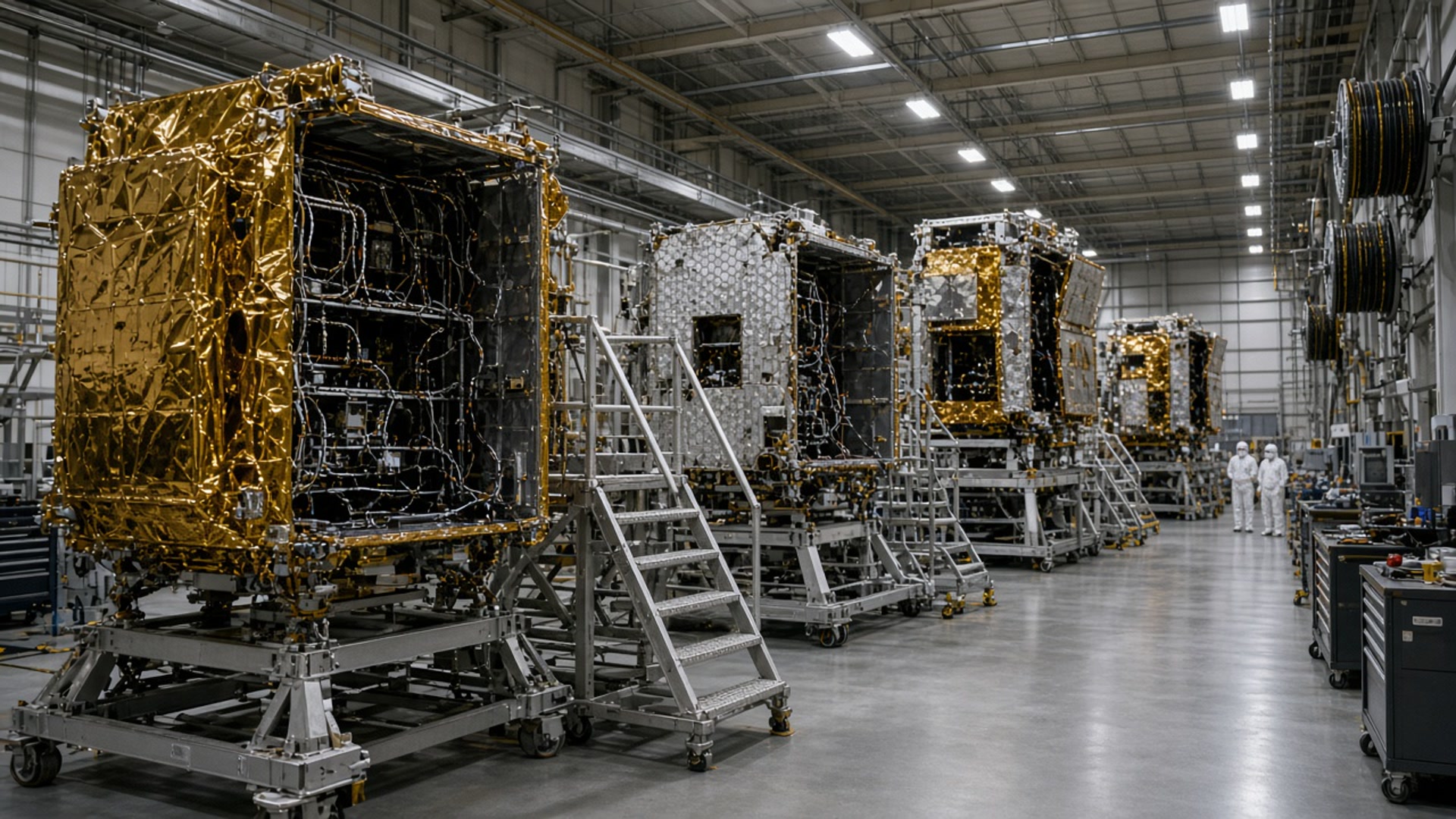
The European Space Agency has extended its two Galileo Second Generation production contracts by two satellites each, adding four spacecraft to the program. Thales Alenia Space in Italy and Airbus Defence and Space in Germany have each been under contract since 2021 to build six. Each now has eight, and the second-generation fleet grows from 12 to 16. ESA announced the order on Oct. 27. Thales Alenia Space signed in Rome on Oct. 23 and Airbus in Ottobrunn on Oct. 26.
ESA signed on behalf of the EU Agency for the Space Programme, which runs the Galileo service for the European Union. Neither ESA nor the two companies gave a value for the extensions.
The new satellites will be identical to the first twelve, so the order adds output to an existing design rather than starting a new one. Delivery is scheduled for 2031, with launch right after. Each satellite will carry a fully digital navigation payload that can be reconfigured in orbit, inter-satellite links, a new atomic clock configuration and protection against jamming and spoofing. Airbus says each weighs more than two metric tons, and both primes cite a 15-year design life.
The first batch is still on the ground. ESA says qualification of the first twelve is nearly complete, flight models start integration and testing in 2027, and the first second-generation launch is planned for 2028. The program has slipped: when the contracts were signed in 2021, a first launch was expected by the end of 2024.
Funded scores, though the price is unpublished. Flown does not yet. Second source is built in: two primes on one constellation, each now with eight satellites to deliver.
In-space servicing
Infinite Orbits raises EUR52 million and locks in four rides to geostationary orbit
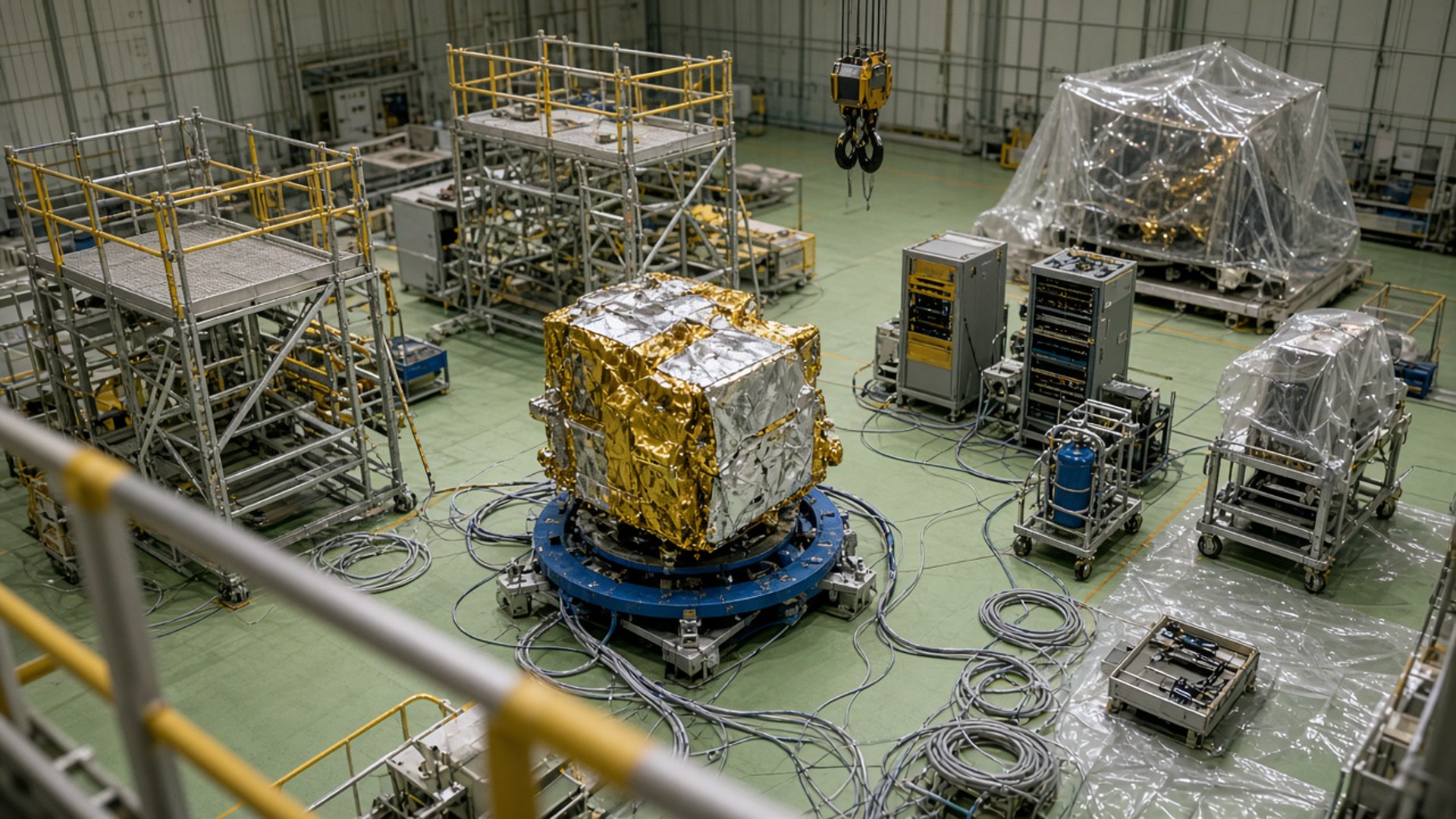
Infinite Orbits, a Toulouse company founded in 2017 that builds spacecraft to rendezvous and dock with satellites in geostationary orbit, has raised EUR52 million across two financing rounds. It announced the funding on Oct. 19.
The money comes with transport. Infinite Orbits holds four firm launch contracts with Impulse Space through 2029, using Impulse's orbital transfer vehicles to carry its servicers to geostationary orbit.
The company lists French Space Command and the fleet operators SES and Eutelsat as customers. The company puts its backlog of firm orders above EUR150 million. That is a company figure, and Infinite Orbits has not broken it down by contract.
The product carrying that backlog is Endurance, a servicer that the company says docks with a client satellite and takes over station keeping for up to five years, without changes to the host spacecraft. The company also says Endurance is compatible with more than 70% of today's end-of-life geostationary satellites. In its funding announcement the company said a first Endurance deployment is planned. In September, Eutelsat and Infinite Orbits announced they intend to work together on a life extension mission for at least one Eutelsat geostationary satellite, a project the two companies say is to prepare a mission capable of servicing satellites built on different platforms.
Funded scores: the equity is raised. Flown does not, since no Endurance has reached orbit. Second source is unproven: the backlog is the company's figure, and until an Endurance docks with a client, European operators have a servicing supplier on contract, not yet one proven in orbit.
Supply chain
MP Space raises A$23 million to build satellite batteries at volume

MP Space, a Sydney company that builds batteries and power systems for spacecraft, has raised A$23 million (about US$16 million) in a seed round. Blackbird led it, with Seraphim Space, Systemiq Capital, Speedinvest and MFV Partners joining. It is Seraphim's first investment in an Australian company. The round was announced on Oct. 26.
The founders, chief executive Jay Manley and chief commercial officer Sam Paterson, are former Tesla engineers who started the company in January 2024. Their pitch is that satellite builders today either buy power hardware from a slow, expensive supply chain or build it themselves.
The company says its systems have been designed into more than 500 spacecraft. That is a design-in count from the company, not a delivery count. Its hardware reached orbit for the first time this month.
The money goes to output. MP Space says it will expand manufacturing capacity in Australia, grow its engineering team and broaden its range of power products. Manley told Payload the goal is 5,000 space widgets a year by the end of next year, a target, not a demonstrated rate.
Funded scores: the round is closed. Flown scores, just, with first units in orbit this month. Second source is the business itself. MP Space is selling itself as a merchant supplier to builders that would otherwise make their own power systems. The test is whether the Sydney line gets near Manley's target of 5,000 space widgets a year.
Earth observation
NASA pays EarthDaily about $3 million to test its data against Landsat

NASA has awarded EarthDaily a contract worth $2,959,635.20, which the company rounds to $3 million, to supply data and technical support from its EarthDaily Constellation. Federal award records show the contract, 80HQTR26C0010, running from Sept. 25, 2026 to Sept. 24, 2027. NASA's posted justification says it was awarded sole source. EarthDaily announced it on Oct. 26.
The work sits inside Sustainable Land Imaging, a joint NASA and U.S. Geological Survey effort to see how commercial data could complement government land imaging. NASA and USGS will check EarthDaily's data against Landsat requirements for calibration, stability, radiometric and geometric performance and how well it can be harmonized with the Landsat record. The tests include running the data through USGS and NASA processing workflows, and looking at products built for machine learning.
EarthDaily says the evaluation will also look at whether more frequent commercial passes could add to Landsat's revisit rate. EarthDaily says eight of its 10 satellites are in orbit, imaging across 22 spectral bands from visible to thermal, at 5 meters in the visible and near infrared. Those are company figures, and testing them against Landsat is the point of the contract.
Funded scores, at evaluation size. Flown scores: EarthDaily says eight of its 10 satellites are in orbit. Second source is what the evaluation could lead to: commercial data as a parallel feed beside a government Landsat record, if EarthDaily's numbers hold up.
End of issue 013
If this was useful, the next one lands in a few days.